
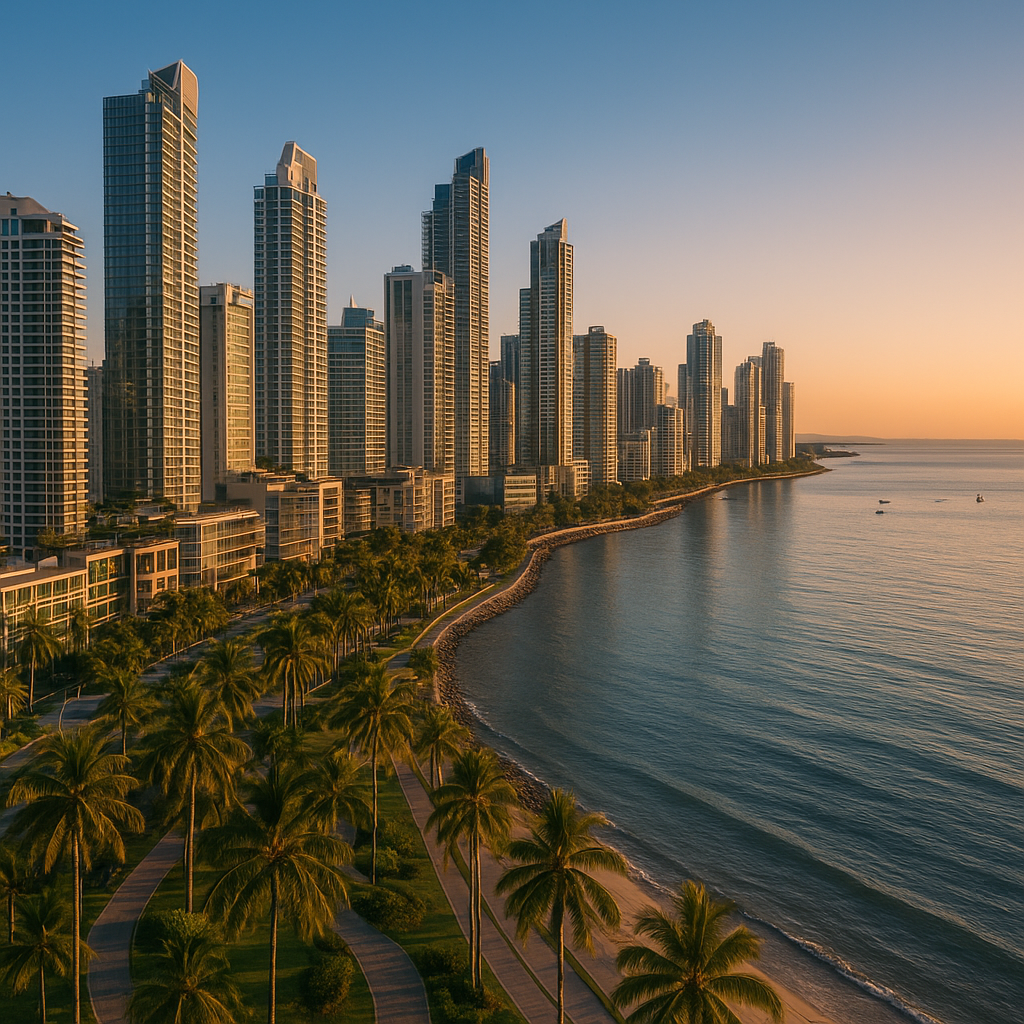
Panama. Territorial Tax Haven in the Americas
Zero tax on foreign-sourced income, a US dollar economy, and one of the most accessible residency programs in the world.
Tax System Overview
Panama operates a territorial tax system, which means it only taxes income that is generated within its own borders. Any income earned from foreign sources, whether that is business revenue from clients in Europe, dividends from US equities, rental income from property in Southeast Asia, or capital gains from selling shares listed on a foreign exchange, is completely exempt from Panamanian taxation. There is no reporting requirement, no filing obligation, and no withholding on foreign-sourced income. It simply does not exist in the eyes of Panama's Direccion General de Ingresos (DGI).
This territorial principle is not a loophole or a special incentive program. It is the foundational architecture of Panama's tax code, enshrined in the Fiscal Code (Codigo Fiscal) since 1956. Unlike many jurisdictions that have moved toward worldwide taxation or introduced controlled foreign corporation rules that pierce territorial treatment, Panama has maintained this system consistently for decades. The stability and predictability of this framework is one of its strongest selling points for international residents and businesses.
For income that is sourced domestically within Panama, the tax rates are moderate and competitive by Latin American standards. Individual income tax follows a progressive bracket system, while corporate income is taxed at a flat 25% rate. Capital gains on domestic assets are taxed at 10%, and dividends from Panama-sourced income face withholding rates of 5% to 10% depending on whether the underlying income was already subject to corporate tax. Panama also levies a 7% value-added tax (ITBMS) on goods and services, which is among the lowest VAT rates in the region.
Individual Income Tax Brackets (Domestic Income Only)
| Taxable Income (USD) | Rate | Notes |
|---|---|---|
| $0 – $11,000 | 0% | Exempt threshold |
| $11,001 – $50,000 | 15% | Middle bracket |
| $50,001 and above | 25% | Top marginal rate |
Key Tax Rates at a Glance
| Tax Type | Rate | Details |
|---|---|---|
| Foreign-Sourced Income | 0% | All types: employment, business, investment, capital gains |
| Corporate Income Tax | 25% | On Panama-sourced income only |
| Capital Gains (Domestic) | 10% | On sale of Panamanian assets (real estate, securities) |
| Dividend WHT (Taxed Profits) | 5% | When corporate income was subject to Panamanian tax |
| Dividend WHT (Exempt/Foreign) | 10% | When underlying income was exempt or foreign-sourced |
| VAT (ITBMS) | 7% | Standard rate; some exemptions for basic goods |
| Wealth Tax | 0% | No wealth, inheritance, or estate tax |
It is worth emphasizing that Panama levies no wealth tax, no inheritance tax, and no estate tax. For individuals planning multi-generational wealth transfers, this makes Panama exceptionally attractive as both a personal residence and an entity domicile. Combined with the territorial system, a properly structured international portfolio can generate income, grow in value, and be transferred to heirs with effectively zero Panamanian taxation at every stage.
Benefits by Origin Country
Panama's territorial system interacts differently with each origin country's tax code. Understanding these interactions is essential to building a compliant and optimized strategy.
For US Citizens
The United States is one of only two countries in the world (alongside Eritrea) that taxes its citizens on worldwide income regardless of where they live. This creates a unique and complex dynamic for Americans relocating to Panama. While Panama will not tax your foreign-sourced income, the IRS still considers every dollar you earn anywhere on the planet as taxable income.
The primary tool for reducing US tax liability while abroad is the Foreign Earned Income Exclusion (FEIE), which allows qualifying taxpayers to exclude up to approximately $130,000 of foreign earned income from US taxation. However, the FEIE only applies to earned income. Investment income, capital gains, rental income, and passive business income remain fully taxable by the IRS. Because Panama imposes zero tax on your foreign-sourced income, there is no Foreign Tax Credit (FTC) available to offset your US tax liability.
- No tax treaty exists between the US and Panama
- FATCA compliance is mandatory: all foreign financial accounts must be reported via FBAR and Form 8938
- GILTI and Subpart F provisions mean Panama corporations do not defer US tax for US shareholders
- Panama PIFs are classified as foreign trusts, requiring Forms 3520 and 3520-A ($10,000 minimum penalty per form per year for non-compliance)
- Exit tax applies if renouncing US citizenship under IRC Section 877A
For UK Citizens
The UK and Panama signed a Double Taxation Agreement in 2016, providing reduced withholding rates and a framework for resolving cross-border tax issues. Under the treaty, pensions are taxable only in the UK, providing clarity for retirees drawing UK pensions while living in Panama.
The critical advantage relates to capital gains. Once you become non-resident for five complete UK tax years, capital gains realized on non-UK assets are no longer subject to UK CGT. Living in Panama during those years means zero CGT in Panama (foreign-sourced) and zero CGT in the UK (non-resident), creating a genuine window of tax-free capital gains realization.
- Non-domicile status was abolished in April 2025. All UK tax residents are now taxed on worldwide income regardless of domicile status
- Split-year treatment may apply in the year of departure under the Statutory Residence Test (SRT)
- UK rental income remains taxable through the Non-Resident Landlord Scheme
- ISAs and UK pensions remain under UK jurisdiction; ISAs lose their tax-free wrapper for non-residents
- Inheritance tax applies on worldwide assets of UK-domiciled individuals under new 20-year residence history rules
For Australian Citizens
Australia does not tax citizens on the basis of citizenship. Once you become a non-resident for Australian tax purposes, you are only taxed on Australian-sourced income. This means Panama's territorial system creates a powerful combination: zero Panamanian tax on foreign-sourced income, and zero Australian tax on non-Australian income once you sever tax residency.
However, the departure itself triggers tax. Australia imposes a CGT Event I1 upon ceasing to be a tax resident, treating you as having disposed of all non-Australian assets at their market value on the date of departure.
- No double tax treaty exists between Australia and Panama
- The 50% CGT discount applies if you choose to pay the departure tax immediately rather than deferring it
- Superannuation remains locked in Australia and continues to grow under Australian tax rules
- Foreign income becomes exempt once you are a confirmed non-resident
- Australian rental income and dividends remain taxable; unfranked dividends subject to 30% withholding for non-residents
- Medicare levy ceases once you are a non-resident, saving 2% on all Australian-sourced income
For Canadian Citizens
Canada taxes based on residency rather than citizenship. Severing Canadian tax residency unlocks the ability to earn foreign income tax-free in Panama. However, Canada has some of the most aggressive departure provisions in the developed world, imposing a departure tax through a deemed disposition of virtually all property at fair market value.
This includes publicly traded securities, private company shares, real estate outside Canada, cryptocurrency, stock options, and almost every other capital property. The only major exception is Canadian real estate, which remains subject to Canadian tax whenever eventually sold.
- No tax treaty exists between Canada and Panama
- RRSP and RRIF withdrawals are subject to a 25% non-resident withholding tax
- TFSA remains in place but no new contributions as a non-resident; withdrawals are not subject to Canadian or Panamanian tax
- CCPC planning is essential before departure; strategies include crystallizing the capital gains exemption ($971,190 lifetime) and estate freezes
- OAS and CPP continue to be paid to non-residents, subject to 25% non-resident withholding
- Principal residence exemption covers years of actual residence plus one
Residency Programs
Panama offers some of the most accessible permanent residency pathways in the world. Unlike many countries that require years of temporary residency before granting permanent status, several of Panama's visa categories lead directly to permanent residency. The country actively courts international residents and retirees, and its immigration framework reflects this with clear requirements, reasonable timelines, and minimal bureaucracy compared to alternatives in Europe or Asia.
Pensionado Visa (Jubilado)
Panama's Pensionado visa is widely regarded as one of the best retiree visa programs in the world. It requires proof of a lifetime pension of at least $1,000 per month from a government or private pension fund. Social Security payments, military pensions, and corporate pensions all qualify. The visa grants immediate permanent residency.
Processing time is typically 4 to 6 months. The visa also grants access to Panama's famous Pensionado discount program: 50% off entertainment, 30% off public transportation, 25% off restaurants, 25% off airline tickets, 20% off medical consultations, 15% off dental and eye care, 10% off prescriptions, 50% off hotel stays, and 25% off energy bills.
The pension requirement is per individual. A married couple needs $1,250 per month combined (the $1,000 base plus $250 for the dependent spouse). Dependent children under 18 add $250 each.
Friendly Nations Visa
The Friendly Nations Visa is Panama's streamlined residency program for citizens of over 50 countries that maintain strong economic and diplomatic ties with Panama. Eligible countries include the United States, Canada, the United Kingdom, Australia, most of the European Union, Japan, South Korea, Israel, and several others.
Applicants must deposit a minimum of $5,000 into a Panamanian bank account and demonstrate an economic tie to Panama. Processing typically takes 2 to 6 months and grants immediate permanent residency. There is no minimum stay requirement to maintain the residency.
- No minimum age requirement
- No language proficiency requirement for the visa itself
- Dependent spouse and children under 25 (if enrolled in university) can be included
- No proof of income beyond the bank deposit
- Real estate investment of any value satisfies the economic tie requirement
Self-Economic Solvency Visa
For individuals from countries not on the Friendly Nations list, or those who prefer to qualify through a more substantial economic commitment, the Self-Economic Solvency Visa requires a minimum investment of $300,000 in Panamanian assets. This investment can take the form of real estate, a fixed-term bank deposit (CD), or a combination.
The processing timeline is 3 to 6 months, and it leads to permanent residency. The investment must be maintained for the duration of the residency.
- $300,000 minimum in real estate, bank CD, or combination
- An additional $2,000 is required for each dependent
- Assets must remain invested to maintain residency
- No restrictions on nationality (available to all passport holders)
- No income or employment requirements beyond the investment
Path to Panamanian Citizenship
After holding permanent residency for five consecutive years, you become eligible to apply for Panamanian citizenship through naturalization. Panama allows dual citizenship, which means you do not need to renounce your existing nationality.
The citizenship application requires a basic Spanish language proficiency test, knowledge of Panamanian history and civics, no criminal record, and proof of continuous residency.
- 5 years of continuous permanent residency required
- Dual citizenship permitted (no renunciation requirement)
- Spanish language test (basic conversational level)
- Panamanian history and civics knowledge test
- Clean criminal record in Panama and country of origin
- Panama passport provides visa-free access to approximately 140 countries
- Citizens of Spain, Latin American countries, and those married to Panamanians may qualify after 3 years
Cost of Living
Panama City is a modern, cosmopolitan capital that offers a quality of life comparable to mid-tier European or North American cities at a fraction of the cost. The US dollar economy eliminates foreign exchange risk for American expats and provides a stable pricing environment for everyone else. Costs scale significantly based on neighborhood, lifestyle choices, and whether you choose the international expat bubble or integrate into local communities.
The following figures are based on current market rates in Panama City and represent realistic monthly budgets for international residents maintaining a comfortable but not extravagant lifestyle.
Housing
| Housing Type | Monthly Rent (USD) | Notes |
|---|---|---|
| 1-Bedroom, City Center | $850 – $1,200 | Areas like El Cangrejo, San Francisco, Bella Vista |
| 2-3 Bedroom, City Center | $1,200 – $2,000 | Family-friendly buildings with amenities |
| Upscale / Luxury | $1,500 – $5,000 | Punta Pacifica, Costa del Este, Casco Viejo restored |
| Outside City Center | $500 – $900 | Clayton, Albrook, Condado del Rey |
Healthcare & Utilities
| Category | Monthly Cost (USD) | Details |
|---|---|---|
| Private Health Insurance | $100 – $500 | Varies by age, coverage level, and deductible |
| Doctor Visit (Out of Pocket) | $25 – $50 | General practitioner or specialist consultation |
| Electricity | $30 – $250 | Heavily dependent on air conditioning usage |
| Water | $5 – $15 | Some buildings include this in maintenance fees |
| Fiber Internet | ~$38 | 100-300 Mbps plans widely available in the city |
| Mobile Phone | $10 – $30 | Prepaid or postpaid with data |
Monthly Budget Summary
These estimates assume a mid-range lifestyle in Panama City proper. Groceries run approximately $400 to $700 per month for a couple, with local markets significantly cheaper than imported goods. Dining out is affordable by international standards: a quality meal for two at a mid-range restaurant costs $30 to $60, while upscale dining ranges from $80 to $150. Domestic help is common and affordable, with full-time housekeepers earning $400 to $600 per month. Private international schools (which most expat families choose) cost $500 to $1,200 per month per child, with top-tier schools like the International School of Panama at the higher end.
Entity Structuring in Panama
Panama has been a global hub for corporate structuring for over a century. Its legal framework, built on a civil law system heavily influenced by both Spanish and US commercial law, provides a sophisticated and flexible set of entity types designed for international business. The two cornerstone structures are the Sociedad Anonima (S.A.), Panama's equivalent of a corporation, and the Private Interest Foundation (PIF), a unique entity purpose-built for asset protection and estate planning.
Panama S.A. (Sociedad Anonima)
The Panama S.A. is the standard corporate vehicle for conducting business. It can be used for operating businesses, holding investments, owning real estate, or managing intellectual property. Key characteristics:
- Corporate tax rate: 25% on Panama-sourced income only. Income derived from activities outside Panama is entirely exempt
- Annual franchise tax: $300 per year, due by March 15. This is the only ongoing government cost regardless of revenue
- Minimum three directors required, who can be of any nationality and do not need to reside in Panama. Nominee directors are commonly used for privacy
- Bearer shares were eliminated in 2015. All shares must be registered or held in custody by an authorized agent
- No minimum capital requirement. The authorized capital is stated in the articles of incorporation but does not need to be paid in
- Accounting records must be maintained but are not filed with the government unless the S.A. generates Panama-sourced income
- Formation cost: Typically $1,500 to $2,500 including government fees and registered agent for the first year
For businesses operating entirely outside Panama, the S.A. functions as a zero-tax holding or operating company. However, substance requirements are increasingly important for international credibility.
Private Interest Foundation (PIF)
The PIF, established under Law 25 of 1995, is one of Panama's most powerful and distinctive legal structures. It operates similarly to a trust but is a separate legal entity with its own juridical personality. Unlike a trust, a PIF can own property, enter contracts, and sue or be sued in its own name.
- No income tax on the PIF's assets or income, provided all income is derived from foreign sources. Domestic income is taxable at standard rates
- Annual fee: $400 per year, due by the anniversary of incorporation
- Beneficiaries are confidential. The foundation charter names the foundation council members but not the beneficiaries. Beneficiary designations are contained in a private regulations document
- Asset protection: After three years from the transfer of assets into the PIF, those assets are generally protected from the founder's creditors under Panamanian law
- Estate planning: The PIF can hold assets across generations without triggering probate, inheritance tax, or succession proceedings in Panama
- Founder retains control through appointment of foundation council members and the protector. The founder can also be a beneficiary
PIF + IBC Combination Structure
The most common advanced structure combines a PIF with one or more International Business Companies (IBCs) or S.A.s underneath it. The PIF acts as the holding entity and asset protection vehicle, while the underlying companies conduct business operations or hold specific assets. This creates a layered structure with distinct advantages:
- Combined annual cost: Approximately $1,100 to $1,500 per year for the PIF plus one S.A., including government fees and registered agent
- Liability isolation: Business liabilities sit in the operating company, while valuable assets (real estate, investment portfolios, IP) sit in the PIF, insulated from operational risk
- Succession planning: The PIF passes seamlessly to designated beneficiaries without probate, while the operating companies continue to function under the PIF's ownership
- Banking flexibility: The operating company maintains business banking relationships, while the PIF can hold investment accounts separately
Treaty Network and Regulatory Environment
Panama has signed 17 double taxation treaties, including agreements with the UK, Spain, Mexico, South Korea, Singapore, the UAE, and several other jurisdictions. Notably, there is no treaty with the United States, Canada, or Australia. The treaty network is useful for reducing withholding taxes on inbound dividends, interest, and royalties from treaty partners, but its primary value is in the tax information exchange framework rather than direct tax reduction.
Panama does not impose Controlled Foreign Corporation (CFC) rules, which means Panamanian residents are not taxed on the passive income of their foreign subsidiaries. This is the opposite of the approach taken by the US (GILTI/Subpart F), the UK (Chapter 9 TIOPA 2010), and Australia (Division 6 ITAA 1936). For individuals who have severed tax residency in their home country and established genuine Panamanian residency, this absence of CFC rules means foreign holding structures operate free of look-through taxation.
Panama's SEM (Sede de Empresas Multinacionales) regime provides special tax benefits for multinational headquarters operations, including exemptions on foreign-sourced income, reduced rates on certain domestic activities, and work permit facilitation for foreign employees. The SEM regime is designed for businesses with genuine regional headquarters operations in Panama and requires a minimum of five employees and physical office space.
Critical Warning for US Persons: A Panama PIF is classified by the IRS as a foreign trust. US persons who are founders, beneficiaries, or who transfer assets to a PIF must file Forms 3520 and 3520-A annually. Failure to file carries a minimum penalty of $10,000 per form per year, and the IRS has increased enforcement actions in this area since 2020. Any US person considering a PIF must work with a US tax professional who specializes in international trust reporting. Do not rely on Panamanian legal advice alone for US compliance obligations.
Practical Considerations
Moving to a new country involves far more than tax rates and visa requirements. The daily reality of living in Panama is shaped by its infrastructure, culture, climate, and the practical logistics that determine whether a jurisdiction works for your lifestyle long-term. Panama scores exceptionally well on most quality-of-life metrics for an emerging market, with several areas that rival or exceed developed-world standards.
Currency and Financial Stability
Panama uses the US dollar as its official currency (alongside the Balboa, which is pegged 1:1 to the USD and exists only as coins). This eliminates foreign exchange risk entirely for dollar-denominated income and investments. You will never lose money to unfavorable exchange rate movements on your everyday expenses, and pricing transparency is total: the price you see is the price you pay, in the same currency your international investments likely report in. For non-US residents, this provides exposure to the world's reserve currency without the overhead of currency hedging.
Healthcare
Panama's healthcare system is one of the strongest in Latin America. The crown jewel is Hospital Punta Pacifica, a Johns Hopkins International-affiliated facility in Panama City that provides US-standard diagnostic and surgical care at roughly 40% to 60% of US prices. The country also has several other high-quality private hospitals, including Hospital Nacional, Pacifica Salud, and Centro Medico Paitilla. Medical tourism is a growing industry, and many physicians completed their training in the United States or Europe. Dental care and cosmetic procedures are also available at international standards. Private health insurance for a healthy individual under 50 ranges from $100 to $250 per month, with comprehensive plans for older individuals or families running $300 to $500.
Safety
Panama City is safer than most major Latin American capitals. The homicide rate is significantly lower than that of Mexico City, Bogota, or Sao Paulo. The areas where expats typically live (Punta Pacifica, Costa del Este, San Francisco, Clayton, and Casco Viejo) are well-policed and generally safe for walking, dining, and nightlife. Like any major city, awareness and common sense are important, and certain neighborhoods outside the typical expat zones have higher crime rates. The Darien Gap region near the Colombian border is the primary security concern for the country, but it is geographically distant from Panama City and irrelevant to urban residents.
Banking
Panama has a well-developed banking sector with over 70 licensed banks, including international names like Citibank and Scotiabank. However, FATCA compliance has made banking significantly harder for US citizens. Many Panamanian banks now refuse to open accounts for Americans due to the reporting burden and potential IRS penalties. US citizens should expect a more difficult and slower account opening process, often requiring introduction through a Panamanian law firm. Non-US nationals generally find banking straightforward, particularly when opening an account in conjunction with a residency application or corporate formation.
Language
Spanish is essential outside the major business districts of Panama City. Within Punta Pacifica, Costa del Este, and the international business corridors, English is widely spoken in hotels, high-end restaurants, and professional services. But daily life, government offices, healthcare interactions, grocery shopping, dealing with landlords, and virtually all activities outside the expat bubble require at least functional Spanish. Most successful long-term residents invest in language learning during their first year. Panama's Spanish is relatively clear and neutral compared to Caribbean or Southern Cone dialects, making it accessible for learners.
Connectivity and Infrastructure
Tocumen International Airport is the largest hub in Central America and one of the most connected airports in the Americas. Copa Airlines, Panama's flag carrier, operates direct flights to over 80 destinations across North, Central, and South America, as well as to Europe and the Caribbean. For international professionals who travel frequently, this connectivity is a significant advantage over more remote jurisdictions.
Fiber internet is widely available throughout Panama City, with speeds of 100 to 300 Mbps standard and gigabit connections available in newer developments. Cable and Wireless (now +Movil) and Tigo are the primary providers. For digital professionals and remote workers, the infrastructure is reliable and comparable to what you would find in a mid-tier US or European city. Power outages are infrequent in the city center, though a UPS is advisable for critical equipment.
Climate and Environment
Panama has a tropical climate with a dry season (mid-December to mid-April) and a wet season (mid-April to mid-December). Temperatures in Panama City range from 75 to 90 degrees Fahrenheit year-round. The wet season brings daily afternoon thunderstorms that typically last one to two hours. The highland town of Boquete, about a six-hour drive from the capital, offers spring-like temperatures year-round (60 to 80 degrees) and has become popular with retirees who prefer cooler weather. The country's Pacific coast and Caribbean islands offer beach lifestyles, while the Canal Zone and surrounding areas provide suburban living with easy city access.
Important Disclaimer
The information presented on this page is for educational and informational purposes only. It does not constitute legal, tax, or financial advice. Tax laws, residency requirements, and regulatory frameworks change frequently and vary based on individual circumstances. The tax rates, thresholds, and program requirements described here were accurate at the time of writing but may have been updated since. Any relocation or structuring decision should be made in consultation with qualified legal and tax professionals in both your country of origin and your destination country. Geofire Consulting provides strategic guidance and planning frameworks but does not replace the role of licensed attorneys, tax advisors, or accountants in your specific jurisdictions.
Ready to Explore Panama?
Every engagement starts with a confidential strategy session where we assess your specific situation, origin country obligations, and goals.
Book Your Strategy Session