
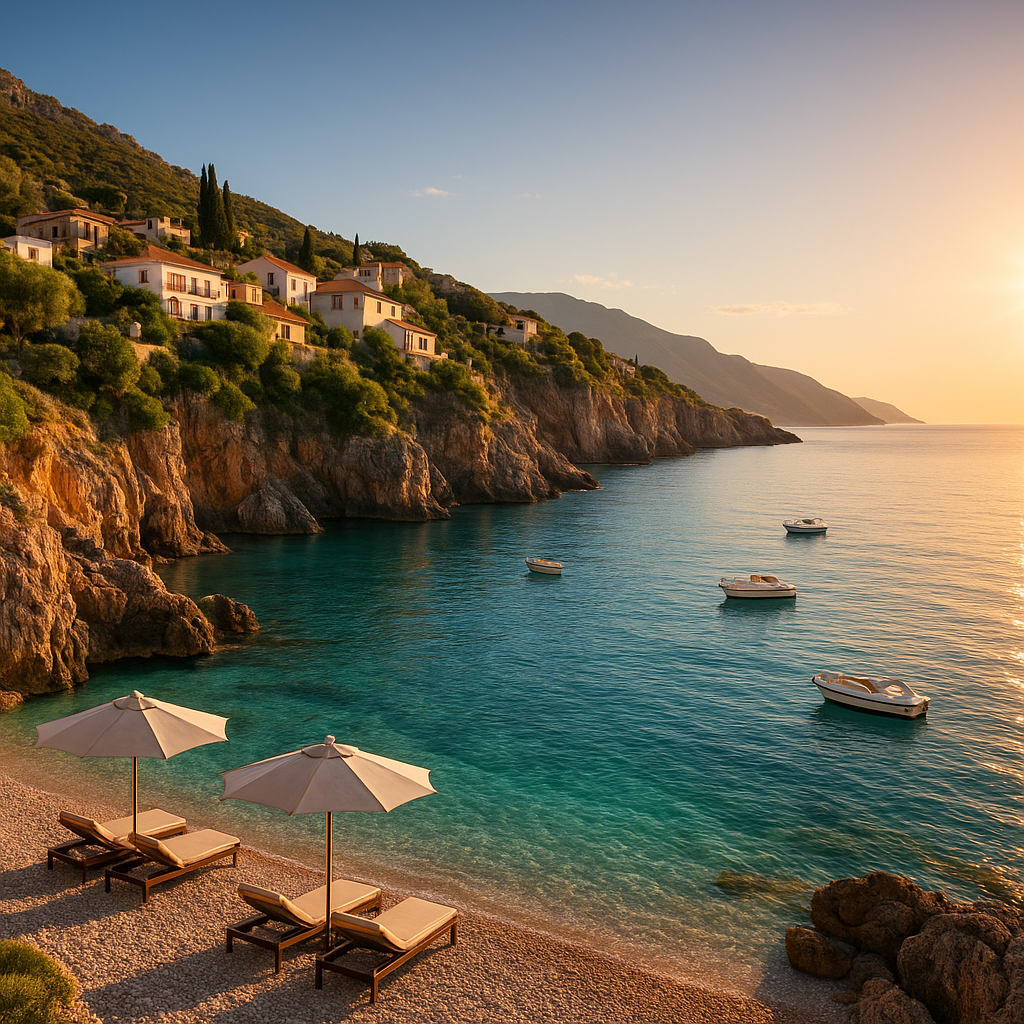
Albania. Europe's Best-Kept Tax Secret
Zero tax on self-employment income up to $117K, an emerging EU candidate with 250 Mbps internet, and a cost of living that makes the math irresistible.
A Tax System Designed for Entrepreneurs
Albania's tax code contains a provision that most international advisors have never read. Self-employed individuals and sole proprietors earning up to ALL 14,000,000 (approximately $117,000 USD) pay zero income tax. Not reduced. Not deferred. Zero. This threshold was enacted as part of Albania's strategy to attract digital workers and entrepreneurs, and it remains in effect through 2029.
Read that figure again. A self-employed consultant, freelancer, or sole proprietor can earn the equivalent of $117,000 in Albania and owe nothing in personal income tax. For context, that same income in the United States would generate approximately $25,000-$30,000 in federal tax alone, before state taxes.
Personal Income Tax Rates
For employment income above the self-employment exemption, Albania applies a progressive system. Income up to ALL 50,000 per month is taxed at 0%. The band from ALL 50,001 to ALL 60,000 is taxed at 13%. Income above ALL 60,000 per month faces a 23% marginal rate. These are not punitive numbers by any standard. Even at the top bracket, Albania's rates sit below the OECD average.
| Income Type | Rate | Notes |
|---|---|---|
| Self-employment (up to ALL 14M) | 0% | Approx. $117K USD. Valid through 2029 |
| Employment (up to ALL 50K/mo) | 0% | Monthly threshold |
| Employment (ALL 50K–60K/mo) | 13% | Marginal rate on this band only |
| Employment (above ALL 60K/mo) | 23% | Top marginal rate |
| Dividends | 8% | Flat rate withholding |
| Capital gains | 15% | Flat rate |
| Interest income | 15% | Flat rate withholding |
Corporate Tax
The standard corporate income tax rate is 15%. But Albania carved out a specific incentive for the technology sector: software development companies pay just 5% corporate tax. This creates a powerful combination. A software company structured as an Albanian entity pays 5% on corporate profits, and its owner pays 8% on distributed dividends. The blended effective rate is roughly 12.6% on distributed profits. Compare that to the 40-50% combined rates common in Western Europe and North America.
Digital Nomad Tax Exemption
Albania introduced a 12-month tax exemption for qualifying digital nomads. During the exemption period, foreign-sourced income earned remotely is not subject to Albanian income tax. This serves as a trial period: live and work in Albania for a year, confirm it fits your lifestyle, then transition to the self-employment exemption or a corporate structure for ongoing tax optimization.
Benefits by Origin Country
Albania has signed 46 double taxation agreements, a network that is broader than many observers expect from a country of 2.8 million people. The treaty coverage includes the jurisdictions most relevant to Geofire clients. Here is how Albania's tax framework interacts with each origin country.
For US Citizens
The US-Albania DTA prevents double taxation on Albanian-sourced income. Combined with the Foreign Earned Income Exclusion ($126,500 for 2024) and Foreign Tax Credits, the effective US tax burden for a self-employed American earning under $117K in Albania can approach zero on both sides. The math works, but it requires precise structuring and strict compliance with FBAR and FATCA reporting requirements.
- Active DTA with full treaty protection
- Reduced withholding rates on cross-border payments
- FEIE + self-employment exemption can eliminate tax on both sides
- FBAR and FATCA reporting mandatory for all foreign accounts
For UK Citizens
The UK-Albania DTA provides full treaty protection with favorable pension and royalty provisions. Once you become non-resident for five complete UK tax years, capital gains on non-UK assets are no longer subject to UK CGT. Combined with Albania's self-employment exemption, this creates a genuine zero-tax corridor for entrepreneurs structuring their departure carefully.
- Active DTA with favorable pension provisions
- Non-dom status abolished April 2025 makes departure planning more critical
- Five-year CGT clock for clean non-resident status
- UK rental income remains taxable via Non-Resident Landlord Scheme
For Australian Citizens
Australia and Albania do not currently have an active DTA. This means potential double taxation on certain income categories. However, Australia does not tax based on citizenship, so once you sever Australian tax residency, non-Australian income escapes Australian tax. The absence of a treaty requires more deliberate structuring to avoid gaps.
- No confirmed treaty between Australia and Albania
- Unilateral relief may apply in some cases
- CGT Event I1 departure tax on ceasing Australian residency
- Superannuation remains locked in Australia under Australian tax rules
For Canadian Citizens
Canada and Albania do not have an active DTA, which means Canadian exit tax planning is critical before relocation. Canada imposes a departure tax through deemed disposition of virtually all property at fair market value. Without treaty protection, careful advance planning is essential to manage the transition.
- No confirmed treaty between Canada and Albania
- Canadian departure tax applies on deemed disposition of assets
- RRSP/RRIF withdrawals subject to 25% non-resident withholding
- CCPC planning essential 12-24 months before departure
Withholding Tax Rates Under Treaty
Albania's treaty-negotiated withholding tax rates on outbound payments follow a tiered ownership structure:
- 0% WHT on dividends where the beneficial owner holds 50% or more of the paying company's capital
- 5% WHT on dividends where the beneficial owner holds 25% or more
- 8% WHT on dividends in all other cases
These rates apply under most of Albania's DTAs, though specific treaties may vary. The 0% rate on majority-held subsidiaries makes Albania attractive as a holding jurisdiction for entrepreneurs who maintain controlling stakes in their operating companies.
Important for Australian and Canadian nationals: Without an active DTA, you may face double taxation on certain income categories. This does not eliminate Albania as an option, but it does require more deliberate structuring. Work with advisors in both jurisdictions to model the actual tax cost before committing to relocation.
Residency Programs
Albania offers multiple residency pathways, each calibrated to a different profile. The barrier to entry is low by European standards. The country is actively competing for international residents, and its immigration framework reflects that priority.
Digital Nomad Unique Permit
Albania's Digital Nomad Unique Permit is the lowest-friction entry point. Requirements are minimal: proof of remote employment or self-employment for a non-Albanian company, health insurance, a clean criminal record, and monthly income of approximately $385 USD. That income threshold is not a typo. Albania set it deliberately low to attract early-career digital workers alongside high-net-worth individuals.
The permit grants 12 months of legal residency with the associated tax exemption on foreign-sourced income. It is renewable and can serve as a stepping stone to longer-term residency.
Investment-Based Residency
For those seeking a more permanent pathway, Albania offers investment-based residency. The investment threshold ranges from approximately EUR 85,000 to EUR 90,000, depending on the investment category. Qualifying investments include real estate, Albanian government bonds, and business establishment with local employment creation.
Investment residency provides immediate access to the Albanian tax system, including the self-employment exemption. It also starts the clock toward permanent residency and eventual citizenship.
Path to Citizenship
Albanian citizenship requires seven years of continuous legal residency. During that period, applicants must demonstrate basic Albanian language proficiency, financial self-sufficiency, and integration into Albanian society. Albania does not currently require renunciation of existing citizenship, making dual citizenship possible for most applicants.
EU Candidate Status
Albania has been an EU candidate since 2014 and has opened 24 of 33 accession chapters. While EU membership is not imminent, the trajectory is clear. Albanian residency today is a strategic bet on future EU access. If Albania joins the EU, current residents would gain freedom of movement across 27 member states, access to the EU single market, and the ability to live and work anywhere in the bloc.
Golden Visa update: Albania's Golden Visa program has been suspended pending an EU ruling on investment-based residency schemes across candidate countries. If the Golden Visa pathway is important to your strategy, monitor this closely. The standard investment-based residency remains available and is unaffected by the suspension.
Where Your Money Goes Further
Albania's cost of living runs 30-50% below equivalent US cities. Not 30-50% below Manhattan. Below average US cities. The gap against London, Sydney, or Vancouver is even wider.
This is not a developing-world compromise. Tirana is a modern European capital with international restaurants, coworking spaces, and a growing expat community. The difference is structural: Albania's economy is still pricing in its pre-EU status, which creates an arbitrage window for anyone earning in dollars, pounds, or euros.
Housing
A one-bedroom apartment in central Tirana rents for EUR 400-600 per month. A well-appointed two-bedroom in the Blloku district, Tirana's most desirable neighborhood, runs EUR 600-900. For context, Blloku is the city's dining, nightlife, and cultural center. These are not peripheral locations.
Purchasing property is also accessible. Apartments in Tirana range from EUR 1,000-1,800 per square meter depending on location and quality. A 100-square-meter apartment in a prime location costs EUR 100,000-180,000. Coastal properties in Saranda or Vlora offer Mediterranean waterfront living at a fraction of Croatian or Greek prices.
Monthly Budget Benchmarks
| Category | Budget (EUR/mo) | Comfortable (EUR/mo) | Premium (EUR/mo) |
|---|---|---|---|
| Rent (1BR, central Tirana) | 400 | 550 | 800+ |
| Groceries | 150 | 250 | 400 |
| Dining out | 100 | 200 | 400 |
| Transport | 30 | 80 | 200 |
| Utilities & internet | 60 | 80 | 120 |
| Health insurance | 50 | 100 | 200 |
| Total | 790 | 1,260 | 2,120+ |
A comfortable lifestyle in Tirana, including a modern apartment, regular dining out, and domestic travel, costs EUR 1,000-1,500 per month. That leaves the vast majority of your income available for investment, savings, or lifestyle spending elsewhere. When combined with the self-employment tax exemption, the effective wealth accumulation rate in Albania significantly outpaces higher-cost European capitals.
Living and Working in Albania
Internet and Digital Infrastructure
Albania's average internet speed of 250 Mbps is the fastest in the Balkans and competitive with Western European benchmarks. This is not an anomaly. Albania leapfrogged legacy copper infrastructure by investing directly in fiber-optic networks. Tirana in particular offers reliable, high-speed connections suitable for video conferencing, large file transfers, and latency-sensitive work.
The coworking ecosystem is developing rapidly. Tirana now hosts over a dozen professional coworking spaces, and the number is growing as the digital nomad community expands. Most offer gigabit connections, meeting rooms, and 24/7 access.
Healthcare
Albania's healthcare system is still developing by Western European standards. Public hospitals provide basic care, but the private sector is where international residents should focus. Private clinics in Tirana offer competent general practice, dental care, and routine diagnostics at a fraction of Western prices.
For complex or specialist procedures, most expats travel to Greece, Italy, or Turkey, all of which are a short flight from Tirana. Medical tourism in the region is well-established, and Albanian residents frequently use Thessaloniki (1.5-hour flight) or Istanbul (1.5-hour flight) for specialist care.
International health insurance is essential and affordable. Comprehensive plans covering Albania plus regional evacuation to EU hospitals cost EUR 50-200 per month depending on age, coverage level, and deductible.
Safety and Security
Albania is one of the safer countries in Europe by violent crime statistics. Tirana's crime rate is lower than most Western European capitals. Petty crime exists at tourist-area levels, comparable to any Mediterranean city. Organized crime, while historically a concern, has diminished substantially as EU integration has driven institutional reform.
The country is politically stable with regular democratic elections and an independent judiciary that is undergoing EU-mandated reform. Property rights are generally respected, though title verification is important when purchasing real estate, as some properties have complex ownership histories dating to the post-communist transition.
Banking
Albania's banking sector is functional and improving. Several international banks operate in the country, including Raiffeisen Bank and OTP Group. Opening a local bank account requires a residency permit, passport, and proof of income or employment. The process typically takes one to two weeks.
Multi-currency accounts are available at major banks. International transfers work reliably through SWIFT, though fees are higher than in Western Europe. Many international residents supplement local banking with accounts at Wise, Revolut, or other fintech platforms for foreign currency management and international transfers.
Albania uses the Lek (ALL) as its local currency, but the euro is widely accepted in practice, particularly for real estate transactions and higher-value purchases. ATMs are abundant in Tirana and major cities.
Language and Culture
Albanian is the official language, and it is not related to any other European language. English proficiency is moderate in Tirana, strong among younger Albanians and professionals, and limited in rural areas. Italian is widely understood, particularly among older generations, due to geographic and cultural proximity.
The expat community is growing but still small compared to Lisbon or Bangkok. This has advantages: genuine cultural immersion, authentic local pricing (not tourist inflation), and the opportunity to build relationships in a market before it saturates. The country's Mediterranean culture, family-oriented values, and hospitality toward foreigners make integration smoother than the language barrier might suggest.
Important Disclaimer
This guide is provided for educational and informational purposes only. It does not constitute legal, tax, or financial advice. Tax laws are complex, vary by jurisdiction, and change frequently. The information presented here reflects general principles current as of March 2026 and may not reflect recent legislative changes. Albania's tax incentives, residency programs, and EU accession status are subject to change without notice. Individual circumstances vary significantly, and the application of Albanian tax provisions depends on specific facts including citizenship, source of income, entity structure, treaty applicability, and substance requirements. You should consult with qualified legal and tax professionals in both your current jurisdiction and Albania before making any relocation or tax planning decisions. Geofire Consulting provides strategic advisory services and works in coordination with licensed legal and tax professionals. We are not a law firm, accounting firm, or registered tax advisor.
Is Albania Right for Your Situation?
The self-employment exemption, EU trajectory, and cost of living create a compelling case. But every situation is different. A strategy session will model the specific numbers for your income, assets, and citizenship to determine whether Albania fits your optimization strategy.